Wedding-Day Responsibilities
Wedding Tips & Guides
Who Is Responsible for What on Your Wedding Day? The Jobs Couples Forget to Assign
Many wedding-day problems begin with one simple assumption: someone else is taking care of it. From cake cutting and champagne service to vendor arrivals, candles, cleanup, and breakdown, every task needs a specific person or company responsible for making sure it happens.

At catering tastings, I sometimes ask couples questions they were not expecting.
Who is cutting the cake?
Who is serving it?
Who is opening the champagne bottles?
Who is pouring the champagne?
Who is lighting the candles?
Who will receive the cake when it arrives?
Who will pack everything up at the end of the night?
Very often, there is a pause.
Not because the couple did anything wrong. These are simply the kinds of details people do not think about when they first imagine their wedding.
They picture the ceremony, the flowers, the dinner, the music, and the dancing.
They usually do not picture someone standing in the back wondering:
“Wait. Who was supposed to do this?”
After years of working weddings through Elegante Catering, I have learned that many wedding-day problems do not begin with something dramatic.
They begin with an assumption.
Someone assumes the venue is doing it.
The venue assumes the coordinator is handling it.
The coordinator assumes the caterer has it.
The caterer was never told about it.
The family thinks someone else volunteered.
And suddenly a very simple job has nobody assigned to it.
That is why one of the most important questions you can ask while planning your wedding is:
Who is responsible for each job?
Not “Who might do it?”
Not “Who usually does it?”
Not “I think the caterer takes care of that.”
A real name.
A real company.
A clear answer.
A Wedding Has More Jobs Than Couples Realize
A wedding may look effortless to guests.
That is usually because a lot of people worked very hard to make it feel that way.
Before your first guest arrives, vendors may already be unloading flowers, setting tables, testing microphones, preparing food, arranging decorations, chilling drinks, checking lighting, and solving small problems nobody will ever know happened.
Then the wedding starts.
Now there are new responsibilities.
Someone may need to cue the ceremony.
Someone needs to receive late vendors.
Someone needs to answer questions.
Someone needs to make sure dinner starts on time.
Someone needs to know when champagne should be poured.
Someone needs to know when the cake is being cut.
And when the party ends, the work is not over.
Personal decorations may need to be packed.
Gifts and cards need to be secured.
Rentals may need to be collected.
Trash needs to be handled.
Leftover food needs a plan.
Someone needs to know what happens to everything that is still sitting in the room after the couple leaves.
Each individual job may sound small.
Put all of them together, and you begin to understand how much work happens behind the scenes.
Being Responsible Does Not Always Mean Doing the Physical Work
This is an important difference.
The person responsible for a task does not always have to be the person physically doing it.
A coordinator may be responsible for making sure the reception room is ready.
That does not necessarily mean the coordinator personally moved every chair, placed every fork, lit every candle, and folded every napkin.
A caterer may be responsible for dinner service.
That does not automatically mean the catering team is responsible for moving rental furniture or packing the couple's personal decorations afterward.
A venue may provide tables and chairs.
That does not automatically tell you who is responsible for arranging them exactly the way you want.
The goal is not to make one person do everything.
The goal is to know:
Who is making sure each job actually happens?
That one difference can prevent a lot of confusion.
Your Coordinator's Job Is to Coordinate
Wedding coordinators do important work.
They may build the timeline, communicate with vendors, cue the ceremony, solve problems, answer questions, manage transitions, and help keep the day moving.
Some coordination packages also include personal décor setup or breakdown.
Others do not.
Some include assistants.
Others provide additional staff when the guest count, venue size, décor, or schedule requires it.
That is why I would never tell a couple:
“Your coordinator should automatically do all of this.”
Instead, ask.
If your coordinator tells you:
“Yes, we will take care of setting everything up.”
Great.
Your next question can simply be:
“How many people will be there to do it?”
That is not an insult.
It is a planning question.
If you have 150 guests, dozens of tables, candles, signs, favors, place settings, vendor arrivals, ceremony duties, and a room that needs to be changed during the event, it is reasonable to understand how the work will actually get done.
One person can be extremely talented.
One person still cannot physically be in three places at the same time.

Ask who performs each task, how many staff are needed, and what the contract includes.
Ask How Many People Are Actually Coming
This is one of the questions I think couples should ask more often.
Not only:
“Do you provide setup?”
Ask:
“Who is doing the setup?”
Not only:
“Will you coordinate my vendors?”
Ask:
“If you're with us at the ceremony when another vendor arrives, who will be at the reception area to help them?”
Not only:
“Do you handle breakdown?”
Ask:
“How many people will be helping with breakdown, and what exactly are they responsible for?”
The answer does not have to be a huge team.
It simply needs to make sense for the amount of work involved.
I have worked events where I arrive as the caterer and the main coordinator is busy with the bride, the wedding party, or the ceremony.
That makes sense. They are doing their job.
But sometimes several vendors arrive at the reception area and nobody is there to give direction.
The caterer looks at the DJ.
The DJ looks at the florist.
The florist looks back at everyone.
And we are all basically asking:
“Who are we supposed to talk to?”
I have also worked with coordination teams where an assistant comes over immediately and says:
“The main coordinator is with the ceremony right now. I'm her assistant. Here's where you need to go.”
That one person can make a huge difference.
Every Service Requires Time and Labor
Here is another part of wedding planning that can be uncomfortable to talk about, but it is important.
Nothing happens by magic.
Every additional service requires someone's time.
Lighting one candle sounds easy.
Lighting 100 candles is a job.
Pouring one glass of water takes seconds.
Keeping water glasses filled for 150 guests throughout dinner is an ongoing service.
Moving one chair is simple.
Moving 150 chairs takes people and time.
Setting one place setting is easy.
Setting 150 complete place settings is labor.
That does not mean every little request should cost a fortune.
It means couples should understand that when more work is added, more labor may be needed.
And labor has a cost.
The best approach is not to be afraid of that conversation.
Ask what is included.
Ask what requires additional staff.
Then decide whether that service is important enough to you to include it.
That is much better than assuming it will happen and discovering on the wedding day that nobody was assigned to do it.
This Is How I Think About Staffing in Catering
At Elegante Catering, I have to think about these questions before we arrive.
If we are doing a full-service catered event, I may plan staffing around roughly one server for every 20 guests for the services we have promised.
Those team members already have responsibilities.
They may be serving food.
They may be bussing tables.
They may be cleaning.
They may be preparing for the next part of service.
Now imagine a couple wants continuous water service added to the experience.
That sounds simple.
But somebody needs to walk the room, watch the glasses, refill them, refill pitchers, and continue doing that while the other staff members are still performing their existing jobs.
That may mean I need additional team members specifically for that service.
It is not that the existing servers do not want to help.
They already have responsibilities.
The same idea applies throughout a wedding.
If you add work, ask whether additional people are needed to perform it properly.
Cake Is a Perfect Example
Cake cutting seems like such a small thing.
The couple cuts the first piece.
Everyone takes pictures.
Then what?
Who cuts the rest of the cake?
Who puts it on plates?
Who distributes it?
Who clears the plates afterward?
Who stores leftover cake?
The bakery may have delivered the cake.
That does not automatically mean they are staying to serve it.
The caterer may be serving dinner.
That does not automatically mean cake service was included.
The coordinator may announce the cake cutting.
That does not automatically mean the coordinator is cutting 100 pieces afterward.
None of those vendors are wrong.
The problem only appears when everyone assumes somebody else is responsible.
The same thing happens with champagne.
Who chills it?
Who opens the bottles?
Who pours it?
Who places the glasses?
Who clears those glasses later?
Again:
Write down who is responsible.
Your Family Should Not Be the Automatic Backup Plan
This deserves an entire article of its own.
Sometimes a parent, cousin, aunt, uncle, sibling, or close friend says:
“Don't worry. I'll take care of it.”
They mean well.
But now that person has a job.
They have to remember when to do it.
They may need to leave the ceremony early.
They may miss dinner.
They may spend cocktail hour setting something up.
They may be cleaning while everyone else is dancing.
Or something else may happen.
They may start enjoying the wedding and forget about the job.
I learned this lesson myself years ago in a situation involving a family member who was supposed to be bartending.
Let's just say the bartender eventually preferred the dance floor. 😄
That story deserves its own article.
Read next: Please Don't Give Your Closest Family Members a Job at Your Wedding.
The lesson is not that family members are irresponsible.
The lesson is that they are guests.
They came because they love you.
Whenever possible, let them experience the wedding with you.
The Small Jobs Couples Forget About
Cake and champagne are only the beginning.
Couples are often surprised by how many small responsibilities appear throughout the day.
Who receives the florist?
Who meets the DJ?
Who lights the candles?
Who places the favors?
Who handles the card box?
Who moves ceremony chairs?
Who helps an elderly guest who needs directions?
Who calls a vendor who is late?
Who handles leftover food?
Who packs personal décor?
Who makes sure rentals end up where they belong?
Who is still working after the couple leaves?
We created a separate guide specifically for these easy-to-forget jobs:
Who Cuts the Cake? 15 Wedding-Day Jobs Couples Assume Someone Else Is Doing
One Coordinator Cannot Be Everywhere at Once
This is another important conversation.
A coordinator might be helping the bride.
The ceremony may be starting.
A vendor may be arriving at the reception area.
A guest may have a question.
The DJ may need power.
The caterer may need to know where to unload.
All of those things can happen at the same time.
This does not mean the coordinator is doing a bad job.
It means weddings have many moving parts.
Depending on the size and complexity of the wedding, assistants or additional team members may be important.
We explore that in:
Your Wedding Coordinator Can't Be Everywhere at Once: How Much Help Do You Actually Need?
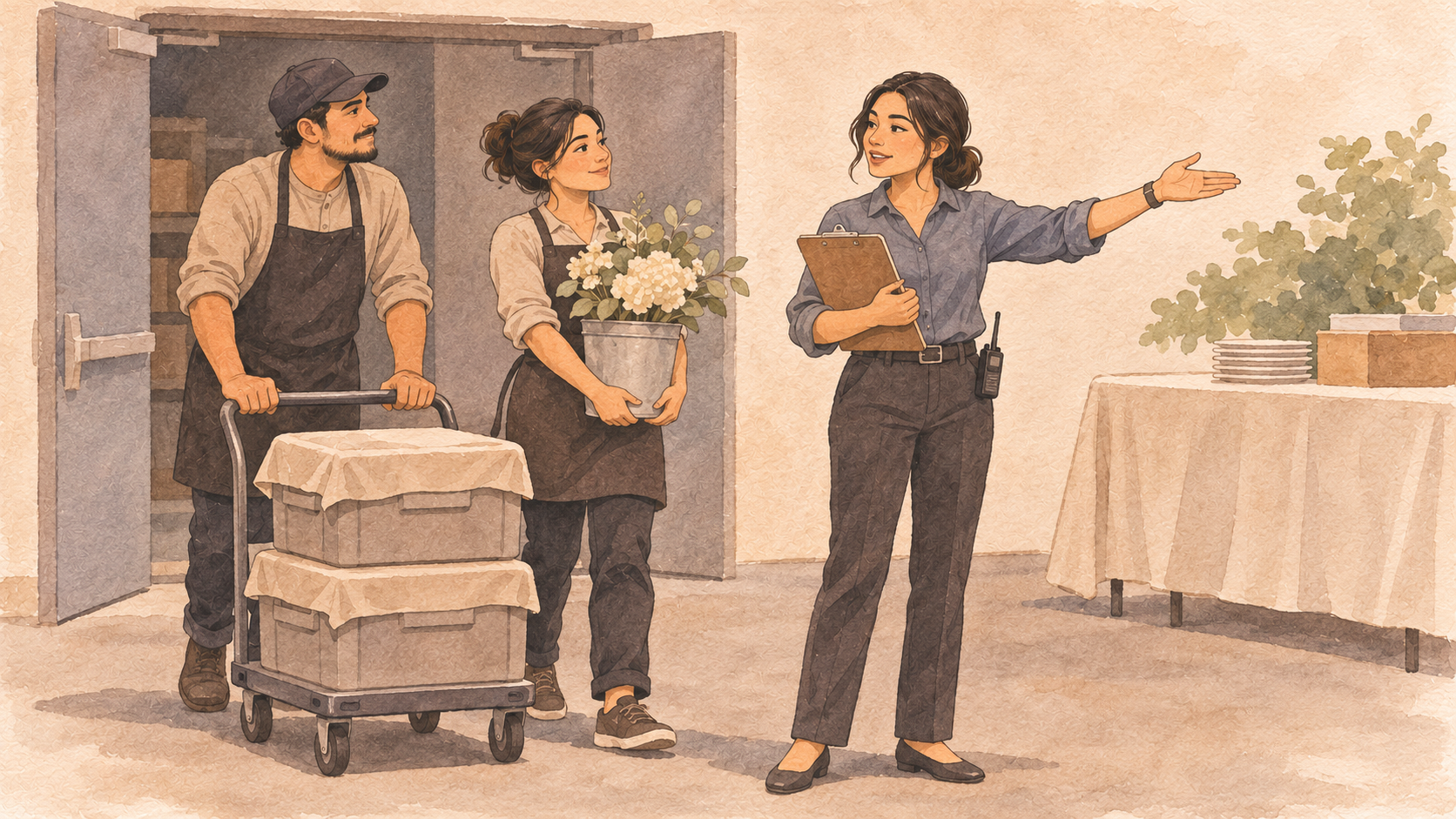
Assign a vendor contact who is available when the main coordinator is elsewhere.
“Just One More Thing” Adds Up
Couples hear this phrase throughout planning:
“It's just one little thing.”
And sometimes it truly is.
But sometimes one small thing multiplied by 100 or 150 guests becomes a real job.
That is why I encourage couples to think about labor without thinking of it negatively.
You are not simply paying someone because they found another thing to charge you for.
You may be paying for someone's time.
Or another staff member.
Or another hour.
Or another person whose only job is making sure that part of your wedding happens correctly.
We go much deeper into that idea here:
Why “Just One More Thing” Isn't Always Simple: The Hidden Labor Behind a Smooth Wedding
Create a Responsibility Plan Before the Wedding
This does not need to become complicated.
You do not need a 100-page operations manual.
You simply need to write down the jobs that matter and assign them.
For every important wedding-day task, write:
What needs to happen?
Who is responsible for making sure it happens?
Is it included in their agreement?
Do they have enough people to do it?
Has that responsibility been confirmed?
If you cannot write a name or company beside a task, that is a sign you still need an answer.
Do not write:
“Someone will take care of it.”
Write:
“Elegante Catering.”
“Venue staff.”
“Maria — coordinator.”
“ABC Rentals.”
“Professional bartender.”
A name creates clarity.
An assumption does not.

Put names, staffing needs, and confirmations in writing before the wedding day.
Download the Wedding-Day Responsibility Planner
To make this easier, we created a printable:
The Wedding-Day Responsibility Planner
It will help couples organize responsibilities into:
- Before Guests Arrive
- Ceremony
- Cocktail Hour
- Reception
- Food & Beverage
- End of Night
- Emergencies and Unexpected Problems
Each task will include space for:
Person or Company Responsible
Included in Contract?
Staff Needed
Confirmed?
Your Wedding-Day Responsibility Planner
Use this seven-page printable planner to assign tasks, check contract coverage, identify staffing needs, and confirm responsibilities.
Download the Wedding-Day Responsibility Planner
Free printable PDF • 7 pages • US Letter, landscape
Never write “someone will do it.” Write the name of the person or company responsible.
How These Lessons Are Shaping The Enchanted Atrium
The Enchanted Atrium is a wedding and special-event venue currently being developed in San Bernardino, California, in the Inland Empire.
The ideas behind the venue are being shaped by years of real event experience through Elegante Catering.
Working weddings has taught me that the things guests never notice are often the things professionals spent the most time planning.
Guest flow matters.
Communication matters.
Vendor access matters.
Staffing matters.
Knowing who is responsible matters.
And clear expectations matter.
Those lessons are shaping every part of our planning.
Our goal is not simply to build a beautiful place for weddings.
We want to create an event experience where couples understand what is happening, who is helping them, and what they can expect.
Because when the responsibilities behind the scenes are handled well, the couple should not have to think about them at all.
They should be enjoying their wedding.
A Simple Question Can Prevent a Big Problem
As you plan your wedding, start asking:
Who is responsible for this?
Then ask:
Is that responsibility actually included?
And if the job involves a lot of physical work:
How many people will be there to do it?
Those three questions can uncover problems while there is still plenty of time to solve them.
You do not need to personally manage every wedding-day detail.
In fact, you should not have to.
You simply need to make sure the responsibility belongs to someone before the wedding begins.
Planning a Future Wedding in the Inland Empire?
The Enchanted Atrium is a wedding and special-event venue currently being developed in San Bernardino, California. Follow our progress, explore our wedding-planning articles, or request information about a future celebration.
Request Information · Join the VIP Interest List
Continue the Wedding-Day Responsibilities Series
Please Don't Give Your Closest Family Members a Job at Your Wedding
Why a well-meaning relative can end up missing your wedding—or leaving an important job unattended.
Who Cuts the Cake? 15 Wedding-Day Jobs Couples Assume Someone Else Is Doing
Cake, champagne, candles, vendor arrivals, cleanup and more—the little jobs that need a real person assigned.
Your Wedding Coordinator Can't Be Everywhere at Once: How Much Help Do You Actually Need?
How to ask about assistants, setup labor, vendor coverage, and whether the wedding-day staffing plan makes sense.
Why “Just One More Thing” Isn't Always Simple: The Hidden Labor Behind a Smooth Wedding
Why small requests become real labor when multiplied across an entire wedding—and why staffing matters.
Frequently Asked Questions
Who is responsible for setting up a wedding?
It depends on the agreements with your venue, coordinator, rental company, caterer, decorator, and other vendors. Do not assume one company handles everything. Ask who is responsible for each part of setup and whether physical setup labor is included.
Does a wedding coordinator set up decorations?
Some coordination packages include small personal décor setup, while others charge separately or exclude physical setup and teardown. Ask exactly what the package includes and how many team members will be present.
Who cuts and serves the wedding cake?
It varies by wedding. The venue, caterer, coordinator, bakery, or another hired professional may provide cake service, but couples should confirm this before the wedding rather than assume it is included.
Should family members help work at the wedding?
Family and friends can help, but remember that giving someone an important job may prevent them from fully enjoying the celebration. Whenever possible, assign important wedding-day responsibilities to professionals or people who are not central to your wedding experience.
How do I know if my wedding has enough staff?
Consider the guest count, venue size, number of vendors, amount of décor, setup requirements, food and beverage service, room changes, and breakdown needs. Ask each vendor how many people they are bringing and which responsibilities those team members are covering.
Explore topics
Written by
Nestor Nidome | The Enchanted Atrium
The team behind The Enchanted Atrium — a wedding and special-event venue in development in San Bernardino, California, built on years of catering weddings and celebrations across the Inland Empire.